
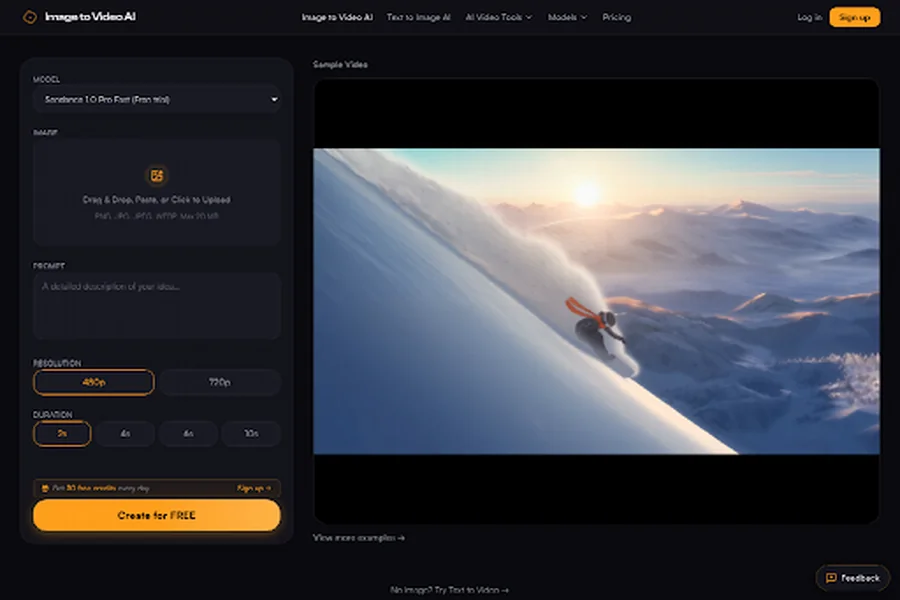
Converting still illustrations into fluid video clips often introduces boundary warping and facial drift. Adopting an optimized image to video ai workflow lets production teams animate high-resolution stills while preserving strict silhouette fidelity.
Modern generative pipelines face a fundamental contradiction between temporal fluidity and spatial accuracy. A static asset contains rich spatial data including skin micropores, directional fabric weaves, subtle depth gradients, and crisp edge contrasts. When a generative diffusion model synthesizes subsequent frames, it must predict where pixel clusters travel across space-time. If temporal attention heads lack rigid spatial anchoring, the model treats subtle texture transitions as fluid noise, generating morphing artifacts that ruin utility.
Deconstructing The Dual Layer Diffusion Pipeline Architecture
To overcome the volatility of temporal frame generation, leading platforms deploy a decoupled two-tier processing framework. The first layer functions as a spatial preservative, capturing a latent representation of the source image while locking key landmarks into place. This layer ensures that geometric volumes, facial proportions, lighting vectors, and silhouettes remain constant across the temporal window. Without this preservation layer, downstream passes rapidly degrade visual assets into unrecognizable approximations.
The secondary layer governs temporal dynamics, calculating vector trajectories and velocity fields across adjacent frames. Platforms like ImgToVideo organize these temporal calculations through specialized cross-frame attention blocks that balance motion vigor against structural preservation. By isolating motion calculations from foundational geometry, the generative engine can simulate organic camera pans, swirling atmospheric particulate, and authentic kinetic gestures without causing the subject matter to dissolve into amorphous mush.
Latent Noise Scheduling And Motion Vector Alignment
The mathematical heart of temporal consistency lies within the latent noise scheduling algorithm. During the forward generation pass, gaussian noise is introduced at varying strengths depending on the intended velocity of movement. High-velocity movements require broader perturbation to allow pixels to traverse larger spatial distances across the screen, whereas subtle organic micro-movements demand tight, constrained noise envelopes.
When the noise envelope is miscalibrated, the model encounters a severe technical failure: latent noise schedules that advance too quickly overpower the original spatial latents, causing high-frequency textures to melt into shimmering digital artifacts. In a rigorous test protocol evaluating rapid camera pans, poorly aligned motion vectors frequently produced unreadable background typography and disintegrated edges. Establishing synchronized cross-attention matrices between the initial reference frame and intermediate latent states preserves critical textural markers, ensuring that motion vectors follow authentic physical trajectories rather than arbitrary pixel migrations.
Preserving Structural Integrity Across High Velocity Frames
A persistent bottleneck in automated video synthesis occurs when attempting to capture dynamic physical actions such as flowing hair, billowing garments, or athletic gestures. In traditional keyframe rendering, artists establish deterministic splines and inverse kinematics to govern behavior. Generative diffusion, by contrast, must infer physical dynamics through statistical probabilities derived from training corpora.

To maintain plausible physics without introducing geometric tearing, contemporary pipelines leverage automated semantic segmentation masks that dynamically track primary subjects across the sequence. These segmentation bounds establish a protected bounding perimeter around critical figures. Within this boundary, motion vectors are strictly regulated to match human physiological articulation, preventing limbs from telescoping or facial features from drifting out of anatomical alignment.
Decoupling Foreground Silhouette Bounds From Background Motion
A frequent point of failure in amateur generative video production involves background motion bleeding into foreground subjects. When a panoramic camera sweep is initiated, an unconstrained diffusion model often applies uniform vector transformation across all depth planes. The consequence is immediate foreground warping: ears stretch horizontally along the camera path, shoulders dissolve into passing scenery, and background objects attach themselves to the subject silhouette.
Decoupling foreground silhouettes from environmental motion vectors resolves this friction. Advanced synthesis engines analyze source stills through depth estimation maps, slicing compositions into discrete foreground, midground, and background strata. When kinetic energy is applied, the background executes parallax translation while foreground silhouettes remain locked to internal coordinates. Technical teams utilizing ImgToVideo benefit directly from this decoupling, producing cinematic reveals while keeping character contours razor-sharp.
Optimizing Motion Amplitude Sliders For Realistic Dynamics
Achieving commercial-grade output requires manual control over kinetic parameters. Production platforms expose motion amplitude controls through numeric sliders that dictate velocity coefficients across the latent canvas. Setting this parameter requires understanding the source composition and its kinetic potential.
Engineers often set motion amplitude to maximum thresholds seeking dramatic action from static portraits. In practice, excessive kinetic coefficients overwhelm temporal attention heads, causing subjects to contort unnaturally as the model hallucinates missing spatial data. Conversely, anemic values produce frozen renders where minor pixel shimmering is the only movement. Striking an ideal kinetic balance transforms a still into a captivating, breathing cinematic snapshot.
Calibrating Temporal Consistency In Subtle Facial Expressions
Facial animation represents the ultimate stress test for any generative image-to-video workflow. Human visual perception is exceptionally sensitive to minute facial distortions, meaning that even fractional millimeter drifts in eyelid geometry or mouth curvature instantly trigger an uncanny valley response. When animating high-resolution character assets, motion settings must be calibrated with surgical precision.
Effective parameter configurations generally prioritize micro-expressions: gentle eyelid blinks, subtle breathing movements in the chest and shoulders, and natural eyebrow shifts. In our rigorous render test workflows, setting the motion amplitude coefficient between twenty-five and forty percent consistently yielded the cleanest results. Within this calibrated corridor, the generative engine preserves iris coloration, lip borders, and facial bone structure, completely avoiding the terrifying warping that characterizes over-amplified generative video renders.
Technical Bottlenecks When Translating Complex Texture Gradients
While generative video systems have advanced substantially, specific visual assets continue to present formidable challenges to latent diffusion architectures. Highly repetitive, intricate geometric patterns—such as houndstooth textiles, fine chainlink fencing, dense architectural louvers, and complex typography—frequently confuse spatial attention mechanisms. As temporal frames advance, the network struggles to track which individual line corresponds to which spatial coordinate, generating distracting moire patterns and temporal flicker.

Production studios facing high-volume asset queues must establish clear intake criteria to identify problematic source imagery before committing processing resources. When complex textures cannot be avoided, applying slight pre-processing diffusion blurs or adjusting contrast ratios in the source still helps the attention mechanism group repetitive patterns into coherent structural blocks. When an asset failed in early production passes due to severe grid moire, adjusting the spatial downsampling filter immediately prevented hours of expensive re-work and eliminated redundant renders that would otherwise have been discarded as unusable.
Furthermore, managing computational overhead remains a vital operational consideration for technical media teams. Every high-resolution synthesis run consumes measurable processing quota, meaning that indiscriminate trial-and-error generation rapidly exhausts operational budgets. By auditing the computational credits spent on failed attempts, engineering leads can refine prompt syntax and motion constraints, ensuring that high-throughput processing queues operate at peak efficiency with minimal resource waste.
Architectural Takeaways For Production Media Engineering Pipelines
The successful integration of neural video synthesis into commercial production pipelines marks a significant milestone in automated content creation. Rather than treating generative video as an unpredictable novelty, forward-thinking technical directors approach the technology as an advanced spatial interpolation engine that thrives under disciplined engineering parameters. By combining robust dual-layer diffusion architectures, strict foreground-background decoupling, and calibrated motion amplitude controls, studios can reliably transform static design portfolios into dynamic commercial assets.
As media workflows continue to evolve, the ability to rapidly produce multi-aspect ratio video assets from single visual seeds will become an essential competitive differentiator. Platforms like ImgToVideo demonstrate that when generative algorithms respect the structural integrity of the original source asset, the output achieves professional broadcast standards. Commercial assets that might once have been discarded or never shipped due to temporal jitter can now be rendered with total visual confidence, unlocking unprecedented creative velocity across digital marketing, entertainment, and interactive software development.
Ultimately, the transition from static graphic assets to living media hinges on deliberate parameter calibration rather than blind automation. Engineering teams that master the interplay between latent noise schedules, subject boundary preservation, and kinetic motion scaling will establish sustainable competitive advantages in the rapidly accelerating world of synthetic media production.
